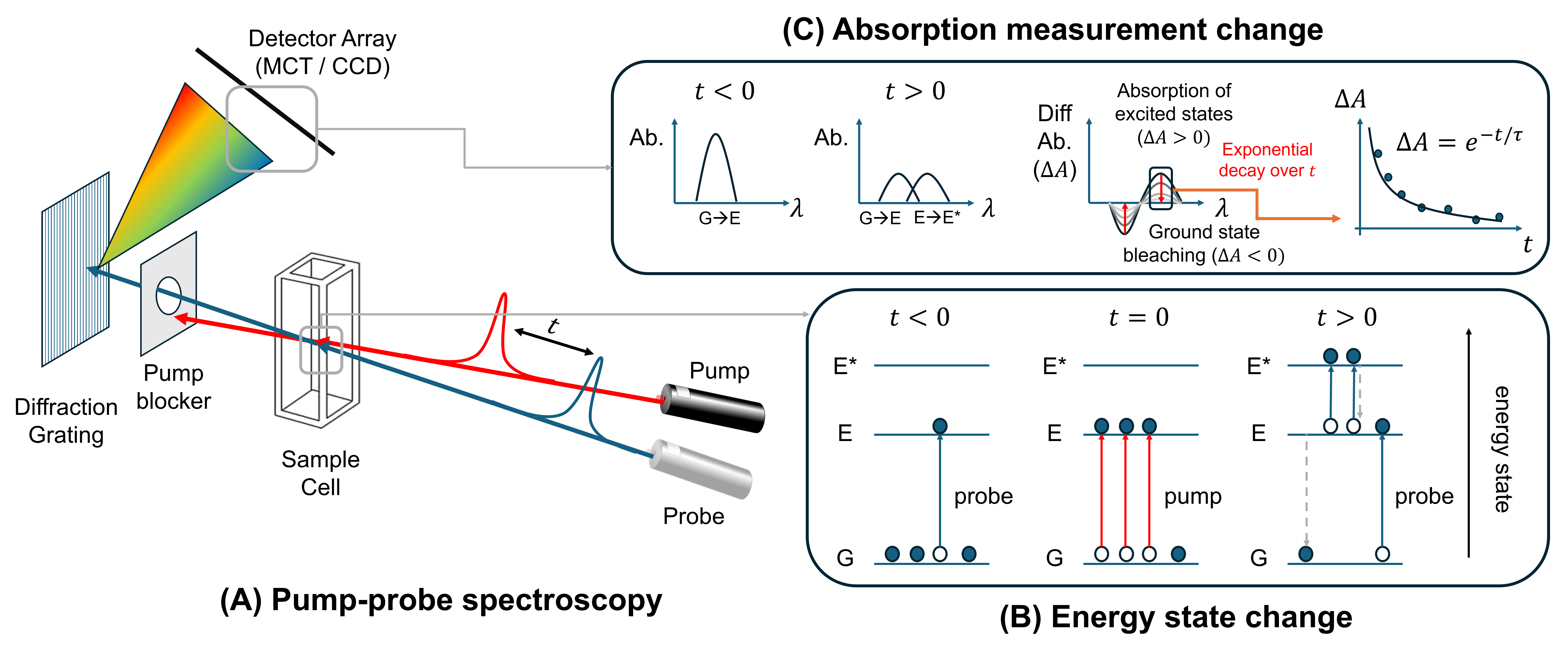
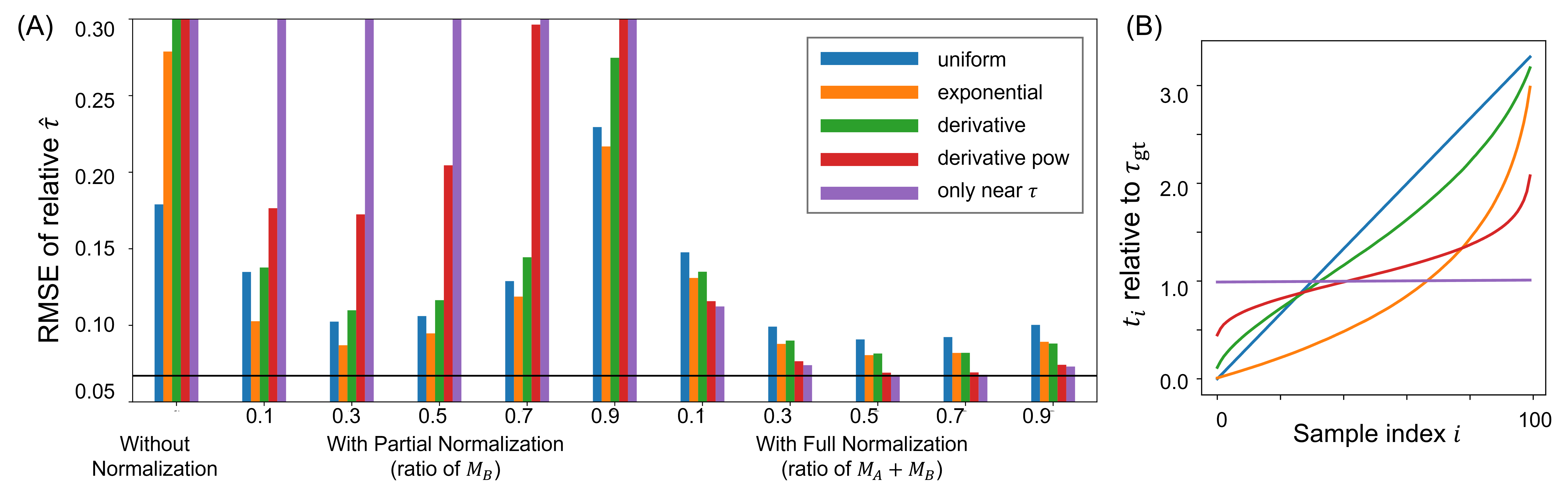
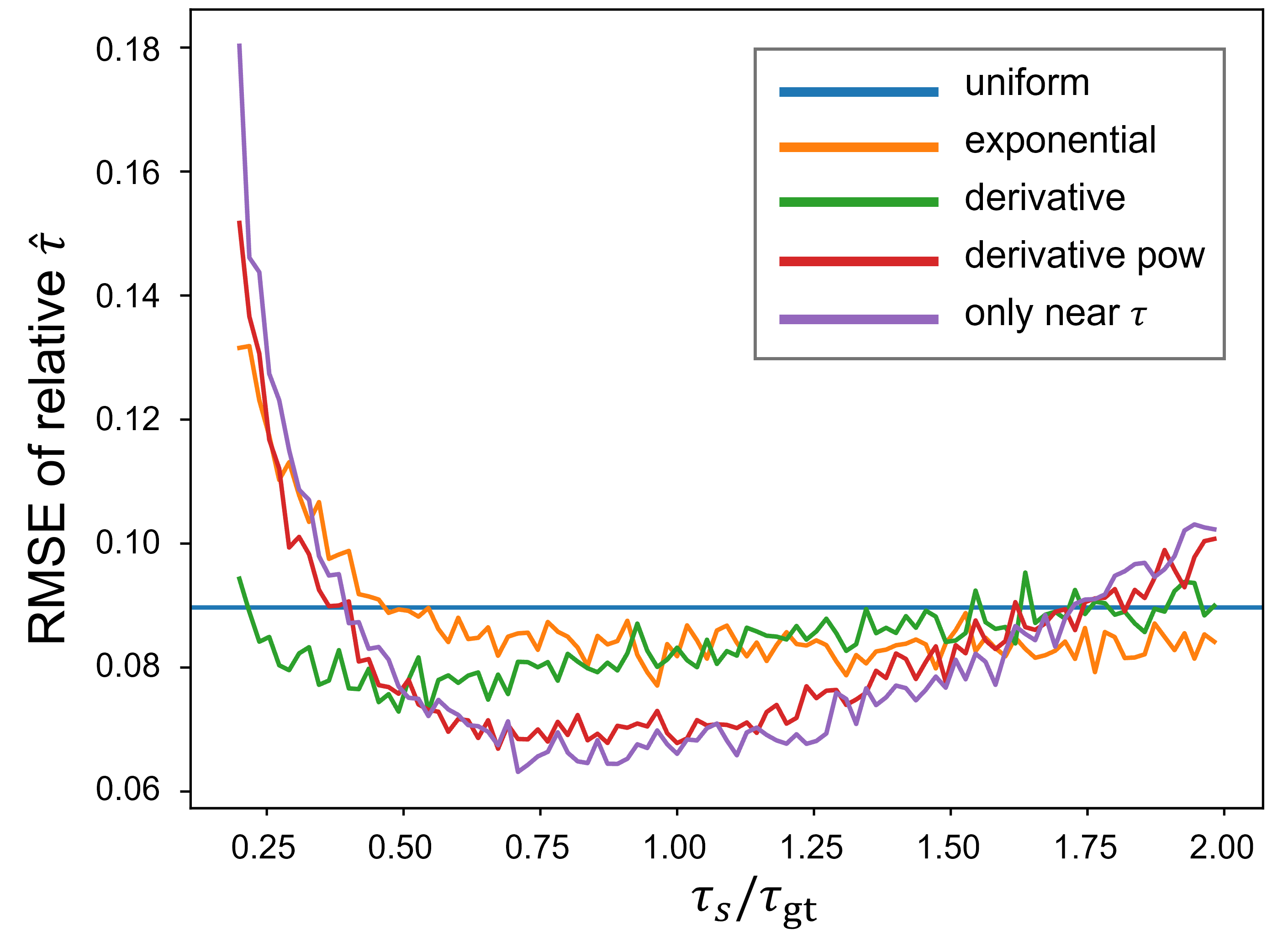
Transient absorption spectroscopy (TAS) is a field of study that investigates the dynamic processes of chemical compounds. Thanks to the recent emergence of ultrafast pulsed lasers, TAS now extends its reach to studying photochemical reactions occurring on timescales ranging from a few femtoseconds to nanoseconds. With ultrafast TAS, changes in sample absorbance or transmittance over time following excitation by pulsed light can be measured at a high temporal resolution of tens of femtoseconds. An application of ultrafast TAS is lifetime measurement for fluorescence decay. However, due to various noise sources (sensor noise, shot noise, unintended photochemical reactions, etc.) during measurement, obtaining a reliable lifetime value often necessitates extensive repetition resulting in experiments lasting several hours. In this paper, we introduce an effective time sampling strategy tailored for lifetime measurement from noisy transient signals. We start with a well-established non-linear curve fitting algorithm and demonstrate that sampling time shifts that maximize the signal derivative ($t=\tau$) will minimize the variance in lifetime estimation. Additionally, we reduce the number of parameters by normalization to ensure the correctness of our algorithm. We demonstrate through simulations that our proposed method outperforms conventional time sampling or normalization methods across various conditions. In particular, we found that the proposed method achieves the same error using 5.5 times fewer samples than the common TAS measurement strategy that uses exponential time sampling with full parameter curve-fitting. Moreover, through real-world TAS measurements, we show that our technique reduces the standard deviation by a factor of 2–8 compared to baseline methods. We expect that our algorithm will be valuable not only for researchers who use TAS but also for researchers across various fields who use time-gated transient cameras for lifetime analysis.
TBA