1Dartmouth College
SIGGRAPH Asia 2026, Conference Track
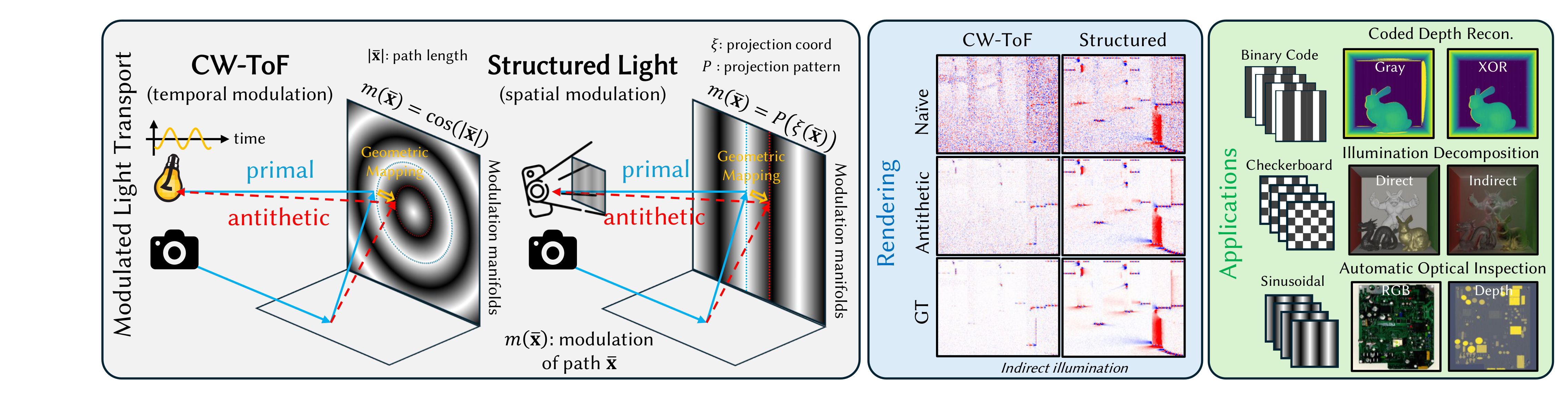
We propose a geometric antithetic sampling strategy for efficiently rendering spatiotemporally modulated light, encompassing both continuous-wave time-of-flight (CW-ToF) and structured light systems. This is motivated by the observation that modulated light transport can be decomposed into a slowly varying geometric term and a rapidly oscillating modulation term, where the latter dominates variance. Our key idea is to construct antithetic sample pairs by geometrically deforming an existing light path so that the modulation term changes sign while preserving similarity in the underlying transport. In both CW-ToF and structured light, antithetic samples lie on an antithetic manifold—the set of configurations with opposite modulation phase—and we search along it to find the path most similar to a given reference path, thereby maintaining strong negative correlation between paired samples. For CW-ToF, this corresponds to shifting paths in optical path-length space, while for structured light, it involves deforming emitter samples along the spatial modulation manifold in projector coordinates. By unifying both cases under this geometric deformation framework, our method effectively cancels high-frequency modulation components through paired samples, leading to significant variance reduction and enabling more efficient simulation of coded illumination and sensing systems which are important in the field of computational imaging.
Citation details will be added when the paper is available.